 |
| Figure 1: Miller-Urey Experiment. |
"We can never know how life really started on earth. Even if we succeed in producing bacteria or bugs that crawl from swirling chemicals in a test tube, we will never know if that is how life actually started on our planet" I feel this quote is the essence of the chapter. In this chapter Lane talks about the origins of life, how it came about, and discusses theories of origin. The main theory of the origin of life spawned from the Miller-Urey Experiment (Figure 1). This experiment showed that the origin of life began through a "primordial soup", being the ocean and the reduced atmosphere being made up of a mixture of reduced gasses: methane, ammonia, and hydrogen. This mixture of gasses all accumulated int he ocean, and with the striking of lightning, they formed into complex polymers. These polymers formed, as Lane says were the basis for life, as they went of to made DNA and RNA which are the biological basis of life (Figure 2). This evolution and origin of life was all the found out through the Miller-Urey Experiment previously mentioned.
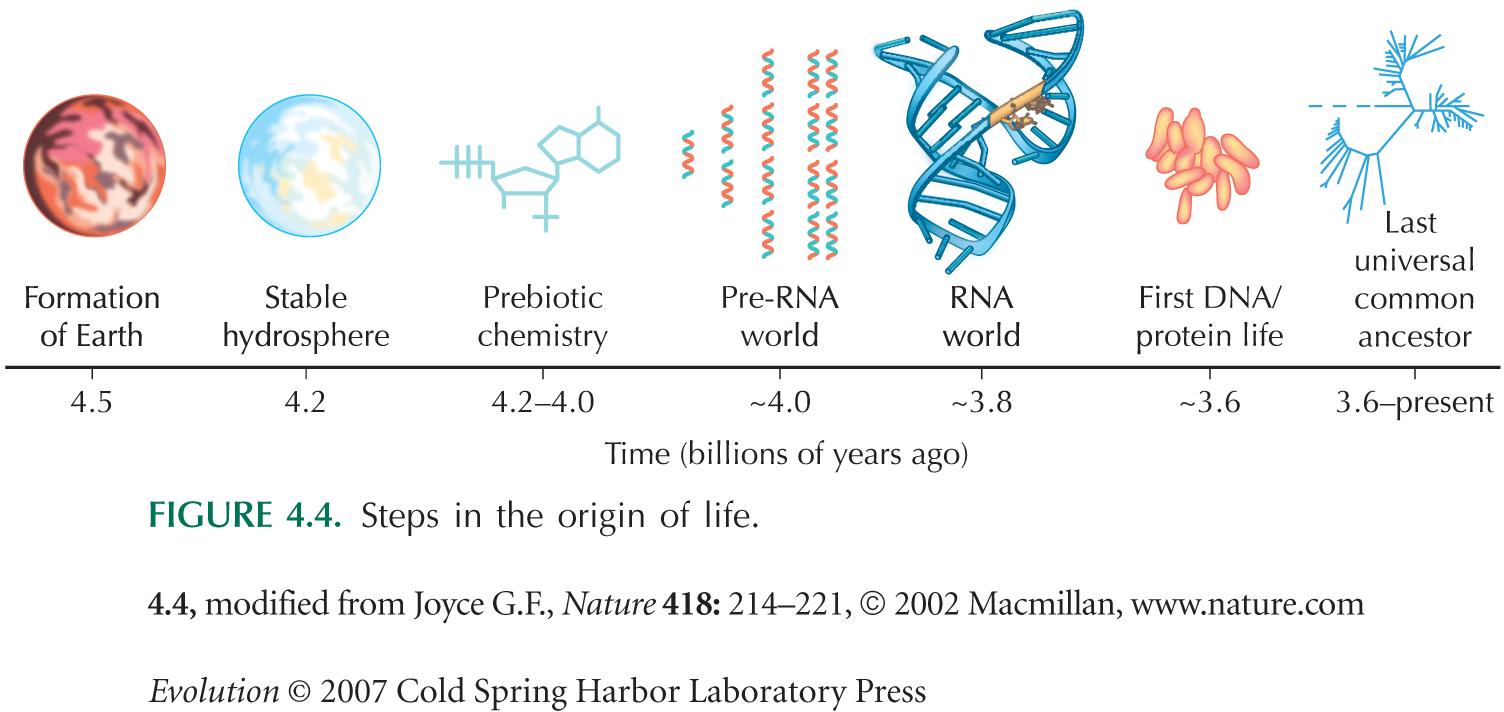 |
| Figure 2: The steps to the origin of life. |
He says "all life is sustained by a ‘main reaction’ of a similar type: a chemical reaction that wants to happen, and releases energy that can be used to power all the side-reactions that make up metabolism." Our whole being in one large reaction, which without we would not be alive. With the large reaction, there would not be any formation of complex molecules to then go on and form the base of life: DNA and RNA. As said before, this large reaction is the basis of out life. The idea of life being one large reaction is called thermodynamics. Lane says the following about thermodynamics, "My point is that thermodynamics makes the world go round. If two molecules don't want to react together, then they won't be easily persuaded; if they don't want to react they will, even if it takes some time to overcome their shyness. Our lives are driven by wants of this kinds."
After reading the first chapter, I am really excited about what the book has to offer in the rest of the chapters, because of how the chapter was formatted. I noticed that he mainly discussed ideas and then proceeded to back them up with scientific facts, in addition he also added a lot of personal commentary which makes reading the chapter more interesting. A lot of the material in the first chapter I studied in AP Biology so the facts didn't surprise me. It really felt like more of a fun review than a scientific reading about evolution; which was great because I had read more than I thought before I knew it. There was not much of the the book that challenged me either, I agreed with a lot that Lane had to say.

No comments:
Post a Comment